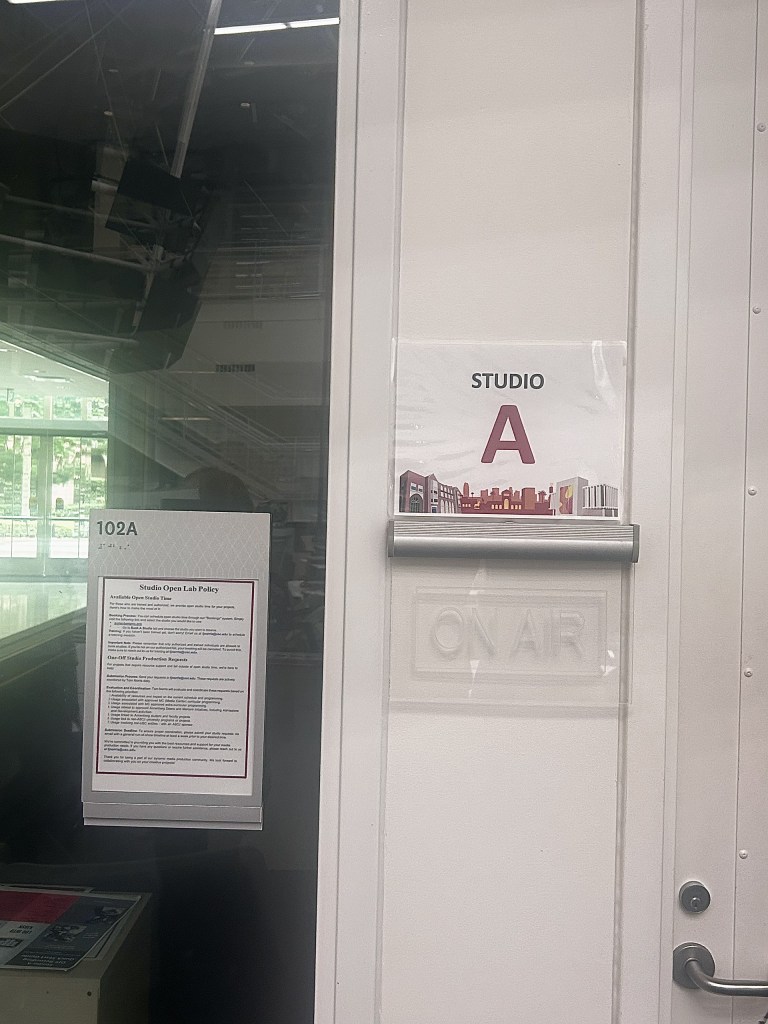
My second week of Annenberg Youth Academy at the University of Southern California was full of fascinating and unforgettable experiences. I appreciated the fresh approaches we took on topics surrounding visual and audio storytelling. My top three highlights from this week that will remain part of my favorite core memories were our trip to the Natural History Museum, the interactive lessons on emotional engagement in podcasts, and our visit to “Studio A” at USC Annenberg’s Media Center. During our interactive lessons, we discussed all the nuanced solutions regarding effective podcasting and its relation to civic engagement. Each lesson delved deep into the processes used to help media stand out in today’s complex civic world.
Our main theme for the week was behind the scenes of media production. For our Communications 101 class, Professor Rogelio lectured about the different ways podcast hosts emotionally engage with their listeners. We discussed the essential question: What makes a podcast stand out? After listening to various hooks, we shared our emotional responses and thoughts on the quality of each introduction. Some of my favorite hooks were the shocking statistics, personal anecdotes, and provocative questions. These instantly struck a nerve inside me and grabbed my attention. In a world where everything is so fast-paced, I find myself looking for clarity and simplistic yet immersive styles of speech. I especially enjoyed listening to the start of an episode on “The Code Switch” podcast. It began with a personal anecdote with a direct, heartfelt message. It brought out my empathy as I understood the emotional pain the interviewee was experiencing through their dialogue. Listening to a variety of different types of podcast introductions helped me gain a better understanding of the power of editing and speech in civic engagement. Furthermore, I realized how greatly ambient background sounds can affect the listener’s perception of a message.
We also learned about how parasocial relationships build intimacy and trust. According to the National Library of Medicine, “Parasocial relationships (PSRs) are nonreciprocal socio-emotional connections with media figures such as celebrities or influencers.” They are essentially a one-sided bond, where an individual feels emotionally connected to a person who isn’t aware of the other person’s existence. In this digital age, we see parasocial relationships all around us. I personally see PSRs as a valuable form of intimate connections with distant listeners when podcasting or producing media. In class, we discussed some of the ways to strengthen a bond with an audience. These include sharing personal stories, posting consistently, and avoiding editing out raw speech patterns such as filler words. Often, by showing up as our most authentic selves, we can build trust, drive action, and bring awareness to the issues that matter to us most.
Overall, my second week at AYA served not only as a place to learn but also a place for me to grow as an individual. Every session was full of new opportunities for us to share critical ideas and perspectives, where representation and diversity mattered. I enjoyed diving deeper into different constructive media frameworks while analyzing the secrets to launching a successful podcast.

