Many people think that change only begins when someone is shown on TV, holding a microphone, or is able to attract a crowd. Yet, this week made me question that notion. It occurred to me that some of the most significant changes in history have been achieved not through images but sound. A voice, broadcasted once via radio or nowadays through a podcast, can cross geographical borders, develop a sense of community, and motivate people to do something without the audience having seen the speaker. And this hidden link might be the strongest type of communication.
Initially, I had my doubts about radio, thinking it as a piece of old technology united to a different generation. Even so, discovering its influential role in social revolutions opened my eyes to something I hadn’t thought of before. McLuhan (1964) argued that a medium has the power to create and manipulation of audiences’ thoughts and interactions. Radio different from written and visual media gives a listener verbal description but not an “ready made” picture. So the listeners have first to imagine surroundings on their own in case of a radio. It is through this process of visualization that the imagination is activated, turning in a sense, into a civic asset.
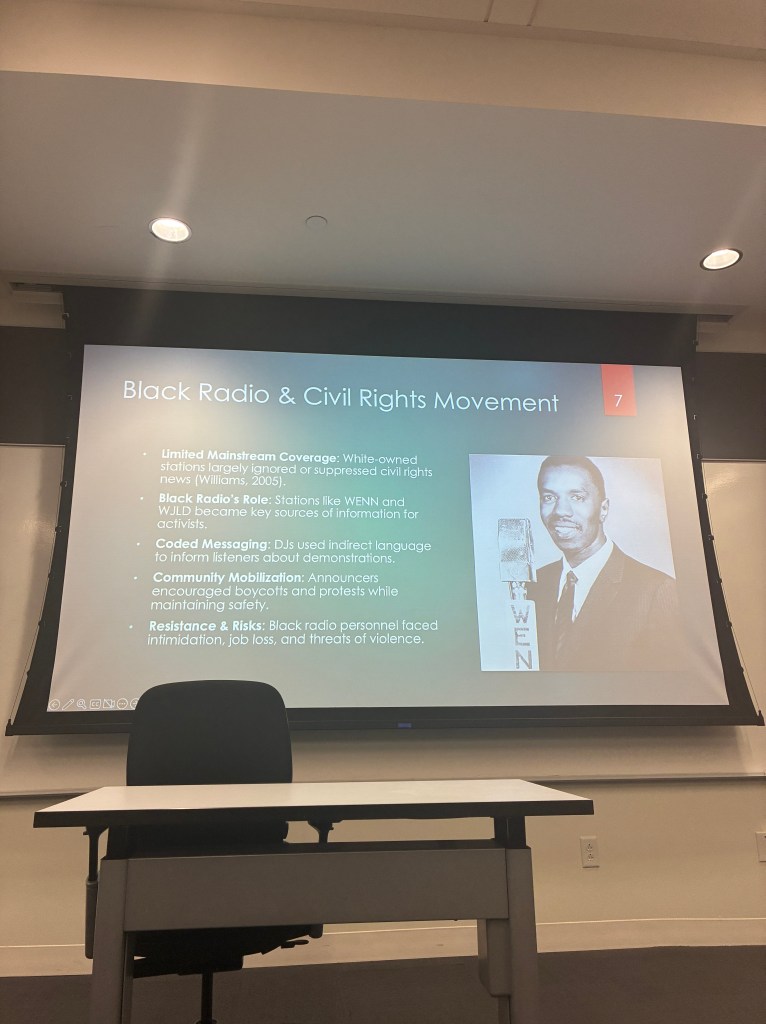
One that mainly stuck with me was the account of Black radio during the Civil Rights Movement. Since most mainstream stations either turned a deaf ear to or downplayed stories about racial injustice, Black communities’ radios turned into safe locations where one could get informed, motivated, and hopeful. DJs were not simply people playing music but rather they helped followers find their way in a very complicated world, issuing messages that were at the same time protective and mobilizing. Such a history shows us that communication, far from being a neutral instrument, can serve to empower or conversely to render communities invisible.
The course made me aware of another point that I find really important, namely the Media Opportunity Structure. It is a model that looks at how media technologies produce different chances for public involvement that depend on the distribution of control among various actors. When amateur radio first appeared on the scene, anyone who wished to engage in producing content professionally was welcome to do so. Still, with the introduction of regulations, the control was taken over by the state and large corporations. We can say that the present stage of podcasting is like the time of amateur radio being ended by government intervention, but the stage is now set differently as we have all this digital technology at our disposal. After only a small investment in equipment, and with digital distribution, creators who are not part of big media companies can again make their voices heard and accuse the major players of public conversations of keeping aside certain points of view. Podcasts show us that story-telling that is substantial does not need to be authorized by big media institutions anymore.
The last, and maybe the most significant, learning that I have gotten from that was about podcast ethics. Many regard editing as nothing but a technical job, but I now see that with each cut, break, and music effect one bears a certain ethical responsibility. Kineikonic mode, as defined by Burn, focuses on truth is the interaction of voice music silence, and pacing produces meaning whereas words alone do not. Mute silence, if it is well placed, may represent sorrow so deeply and honestly that even the strongest and most emotional background music would fail to achieve such a result. Also, if someone makes a false edit it misleads the audience, because moral story-telling is just as crucial as interesting story-telling.
Thinking back on these points, it has really reshaped the way I engage with media on a daily basis. I am now a lot more conscious of who the speakers are in podcast shows, the speed at which interviews are held, and I even notice the ones that the hosts leave empty for so that the audience can deeply think about the challenging concepts. Sound is not an afterthought anymore.