By: Charli Padilla
My second week at the Annenberg Youth Academy (AYA) was an immersive experience filled with lectures, projects, and activities that pushed us to dive deeper into our final projects. For me, the most beneficial lessons this week revolved around the art and technique of podcasting. Being allowed to explore how audio stories are constructed and how they impact audiences truly helped me envision ideas for my final civic media group podcast.
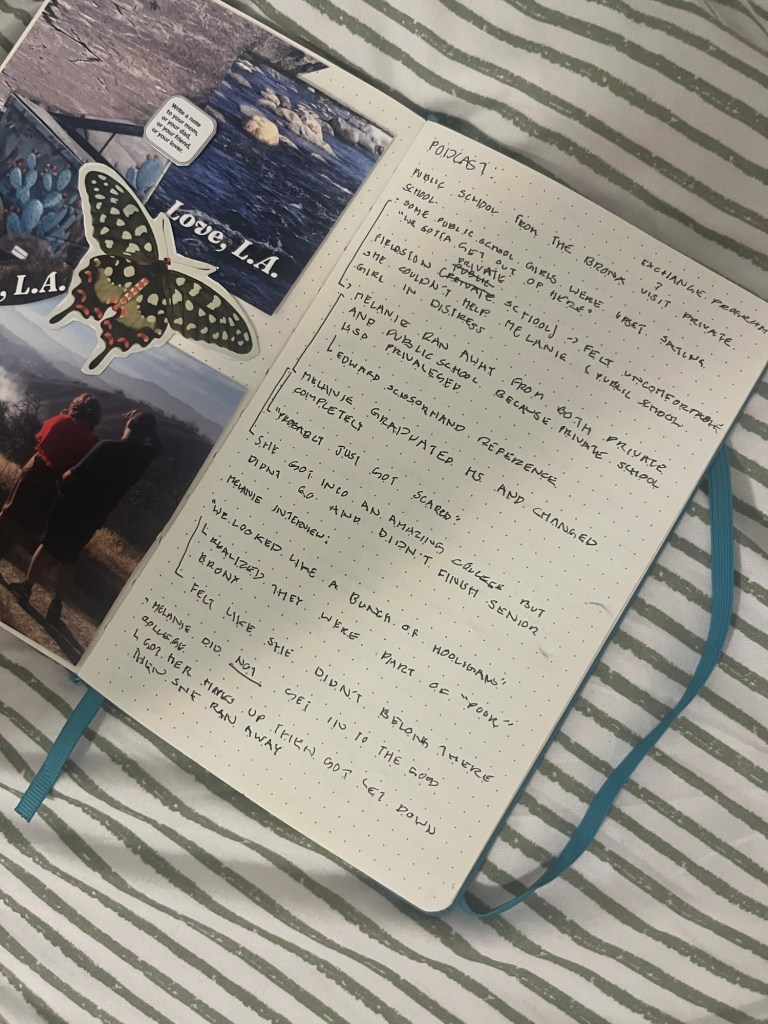
In this photo, you can see a page from my journal that I used to jot down initial ideas while listening and analyzing an assigned podcast.
Throughout our second week in our Comms 101 course, we listened to several assigned podcasts to study the story that they are telling and their production values. The specific recording that stuck out the most to me was an episode entitled “Three Miles” by This American Life. This episode focuses on the deep inequity between different educational systems and explores how these disparities can affect the lives, opportunities, and self esteem of students. For instance, we learned about a public school student named Melanie, who was so shocked by her visit to an affluent private school that it completely changed the trajectory of her academic life.
As we learned more about the technical construction of podcasts, I began to understand why this episode resonated with me. This came down to different production elements like the vocal modulation and the parasocial relationships, which allowed us listeners to build connections with the host and interviewees. Ultimately these techniques made for an impactful episode. “Three miles” served as an excellent example of how a creator can make a piece of media entertaining while still practicing civic engagement. Grasping the balance between these two strategies is exactly what my AYA peers and I must do to create our own meaningful group projects.
Another part of our curriculum was exploring the history of radio and early broadcasting. Learning about the origins of radio helped me understand how audio tools have historically been used to target civic goals. For example, FDR’s “Fireside Chats” offered a perfect demonstration of how early broadcasters mastered tone and pacing to keep their audience calm even during crises. Although FDR was speaking to the United States as a whole, his ability to use his surrounding resources to connect on a human level sparked ideas on how we can use our resources to create podcasts to speak powerfully on civic goals or issues.
Through my second week at AYA I got the opportunity to work with podcast resources and learn more about the construction and history of podcasting. I entered the program with very little interest in podcasting, but I am leaving it excited to listen to more audio stories and produce some of my own.

