
The central theme of week 2 at Annenberg’s Youth Academy was podcasting. In communication, we may not always acknowledge the powerful role that podcasting plays in shaping how we interpret messages. Podcasts follow the general format of written storytelling; we first start with the hook to grab the listener’s attention, with the addition of the introduction, then follow with the body, and lastly the outro. The two narratives are very similar yet very different. Podcasts are guided through a hidden framework to internalize conversations across multimedia platforms.
A recurring element I noticed in “ The Political Thicket” was how consistent the hosts were in incorporating various soundtracks to convey a message. Some audios would be edited to start or end a sentence, while others would be overlapped to echo a sound. I found this technique to be very interesting since it revealed how audio can enhance a podcast’s entertainment. Audio not only structures an idea but also builds on the literary device pathos by allowing listeners to feel a part of the conversation. This brings me to my next point: The Media-Specific Framework of Intimacy. Unlike mass media production, podcasting leads with a unique order of closeness between the speaker and listener. Listening to a podcast through headphones creates an illusion of proximity, making the listener feel included in a “third-party” conversation as part of personal consumption. They also mimic an algorithm of emotional engagement. The inclusion of mixed audio helps listeners engage in episodes by inviting them to different places via background sound, credible voices, and shared values. Listening to a podcast through headphones creates an illusion of proximity, making the listener envision themselves in the direct setting being described to them. In comparison, sound design and mixing audio create this invisible architecture, post production edits are made to draw listeners into the imagination of realism.
Another reference I would like to make would be in UCLA’s Labor Center podcast episode “Coming Home”. Something I found meaningful in this episode was how the editors made the decision to keep the interviewees’ informal vocabulary/slang and mistakes built around nervousness. I believe this was an intentional edit to emphasize authentic speech. With an unedited audio recording, listeners are able to relate to a speaker by connecting with their tone, vocabulary, and sense of thinking on a deeper level. Hosts do this to set a conversational tone throughout an episode. Casual speaking is what’s encouraged for a successful podcast since it’s the best way to connect with a larger audience. All in all, podcasts’ biggest strength in perception is intimacy. Each detail woven into a podcast piece together forms an episode to construct a personal connection between the speaker and listener.
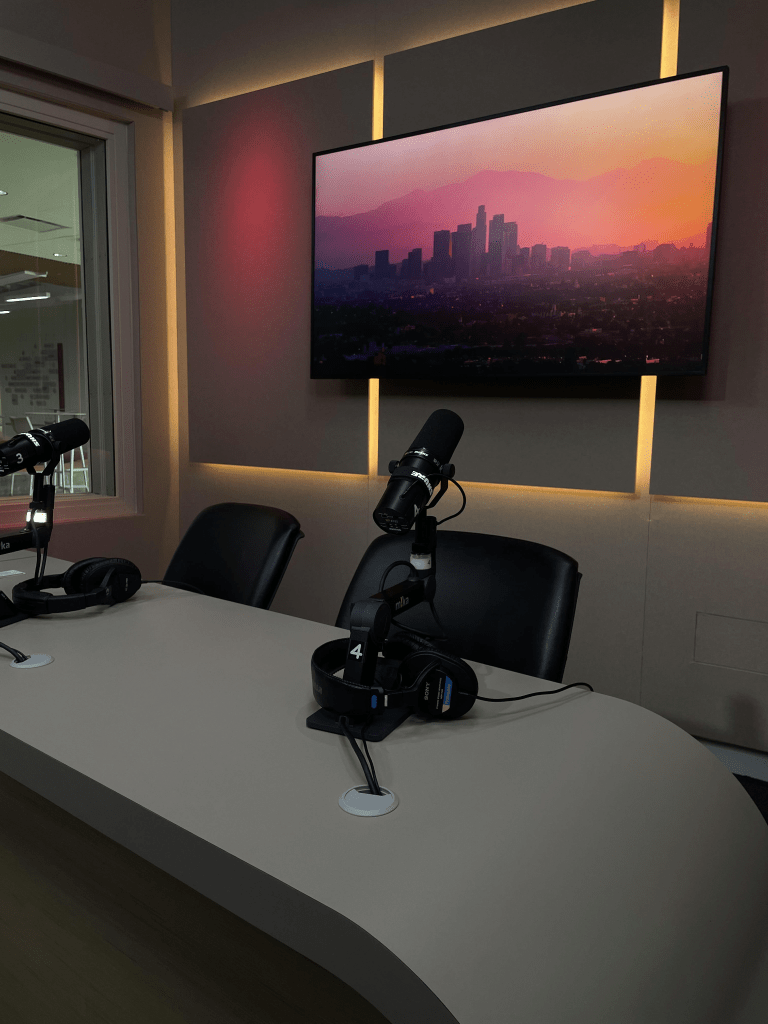
This photo takes place in Annenberg’s Broadcasting room. AYA students had the opportunity to demonstrate their developed public speaking skills via “on-air” performance. Utilizing professional equipment, students gained a sense of what it’s like to be a part of a team/a creator of a series, show, and even live reporting.

