Writing my last COMM101 reflection made me realize that this week’s topic was a fitting way to wrap up the course. Over the past two and a half weeks, I have learned about many different parts of communication, and this week gave me a different perspective on them. Through the assigned podcasts, class discussions, and working with my group on our proposal, I started paying more attention to what goes into telling a story. Before, I mostly focused on the finished product. I didn’t realize how much goes into creating something before you ever see the finished product.
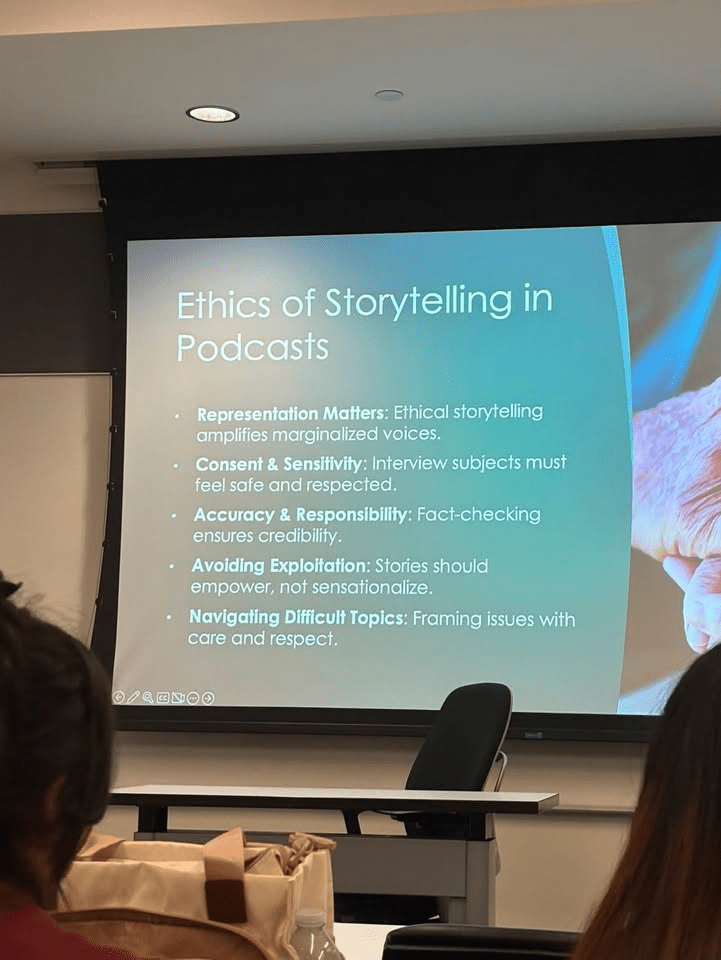
Looking back at the photo I took during class, I remembered our discussion about the ethics of storytelling. We talked about representation, consent, accuracy, and how editing can change the way a story is understood. Before this week, I never really thought about everything that happens after someone shares their story. Now I think more about the editing, the clips that are chosen, and how those decisions can change what the audience takes away. That discussion also changed the way I thought about the assigned podcasts. Instead of only paying attention to the story, I started noticing the choices the creators made to tell it.
One reading that stood out to me was Renee Hobbs’ discussion on podcasting. I liked how she explained that podcasts are more than someone talking into a microphone. The speaker’s voice, pacing, music, and editing all work together to tell a story. After listening to the assigned podcasts, I started noticing those details instead of only focusing on what people were saying. One thing I found myself paying attention to was the use of sound. Some of the dramatic sound effects reminded me of old cartoons like Tom and Jerry or the early black-and-white Mickey Mouse cartoons, where music and sound helped tell the story just as much as the characters did. I had never made that connection before, and it made me realize that sound is part of the storytelling itself.
As I was reading Marshall Ganz’s Public Narrative, Collective Action, and Power, one idea stuck with me. He explains that stories help people connect with ideas in a way that facts alone cannot. That made me think about the podcasts we listened to this week and even the proposal my group has been working on. In both cases, it was not enough to simply explain an idea. We also had to think about how to make people understand why it mattered. It made me realize that explaining an idea and helping people care about it are two different things.
This week changed the way I think about storytelling. I still enjoy learning about how podcasts are made and how creative podcast hosts are behind the scenes. I now notice the editing, pacing, sound, and the way stories are organized because those details can completely change how a message is understood. I also think the next time I open Cap Cut to edit a video, I will approach it differently. Instead of only thinking about transitions or background music, I will think more about whether those choices actually help tell the story. I think that is one lesson from COMM101 that I will continue using even after the program ends.
 Communicating Change