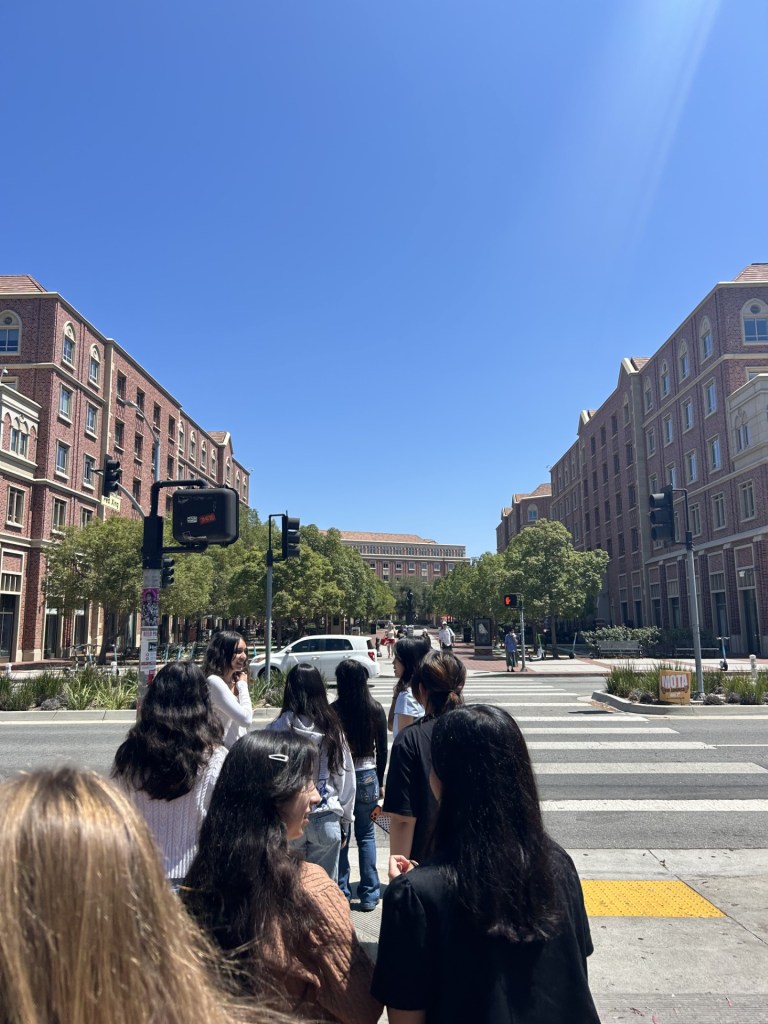
I will never forget the immense happiness I felt stepping onto the University of Southern California campus for the first time. Walking up to the School of Communication and Journalism felt surreal. I was greeted with some of the friendliest students I have ever met while we all completed Bingo charts for a welcome activity. Professor Rogelio, in our Communications 101 class, had each of us introduce ourselves and share a fictional character we identified with. As I listened to the various characters mentioned, I realized that every student was innovative with a distinct set of skills and life experiences. I was thrilled to be a part of a community where asking questions and exploring new ideas was welcomed.
On the first day of the COMM 101 class, we discussed why it’s so crucial to be critical of the media we consume. Through visual illustrations and models, we experienced in real time how media shapes the way we interpret interactions. Stuart Hall’s cultural studies theory explores the idea of encoding and decoding messages. Messages are encoded with meaning by the author and decoded by the recipient. We read about the different types of decoding, such as dominant, negotiated, and resistant forms of perception. These concepts help us understand how to be critical of the media we consume. By questioning the underlying meaning behind the stories we’re told, we can stay informed and work toward change.
On days three and four, we learned about how vital graphic design is in the civic media world. I believe the power of graphics is often overlooked as our brains process images subconsciously. We discussed the psychology behind certain slogans, colors, and visual representations, and how they implicitly convey messages. Furthermore, visual representations are influential ways to raise awareness on different civic issues and challenge the status quo. In the 1900s, Du Bois was invited to present at the Paris World Fair on African American life in the United States. We read about how Bois used graphic design to represent his culture and advocate for social justice. He used visual storytelling as a transformative way to craft a narrative about his experiences and the lives of others to combat institutional racism.
My first week exploring the COMM 101 class has been a great opportunity for me to immerse myself in topics surrounding media literacy and graphic design. I’m looking forward to learning more alongside such talented individuals, as I continue my journey at the Annenberg Youth Academy.

