By: Amaiya Medley
This week, a word that resonated with me everywhere I turned was “community.” I didn’t expect that to be my key takeaway, but by the time we left the Natural History Museum today, I could not think about anything else.
In COMM 101, we recorded a podcast together as a class. Lots of people came up to share their opinions on AI. Some people agreed, some did not, but nobody made anyone feel uncomfortable for their opinion. Which is community. I think that connects to what we covered in our readings and lessons, and to the Renee Hobbs reading, podcasts are intimate because someone speaking in your ear feels personal and direct. When people feel safe enough to speak, you get something deeper and more personal responses from them, and that’s what happened in our class this week.
Marshall Ganz’s Public Narrative model started to make sense to me in a way I wasn’t expecting, either, when we first did it in class, “Story of Self, Story of Us, Story of Now.” The Story of Us is about community. Where your personal story expands into something shared within a room. I was able to further connect this to the Natural History Museum, community is something you recognize because it was there before you even got there.
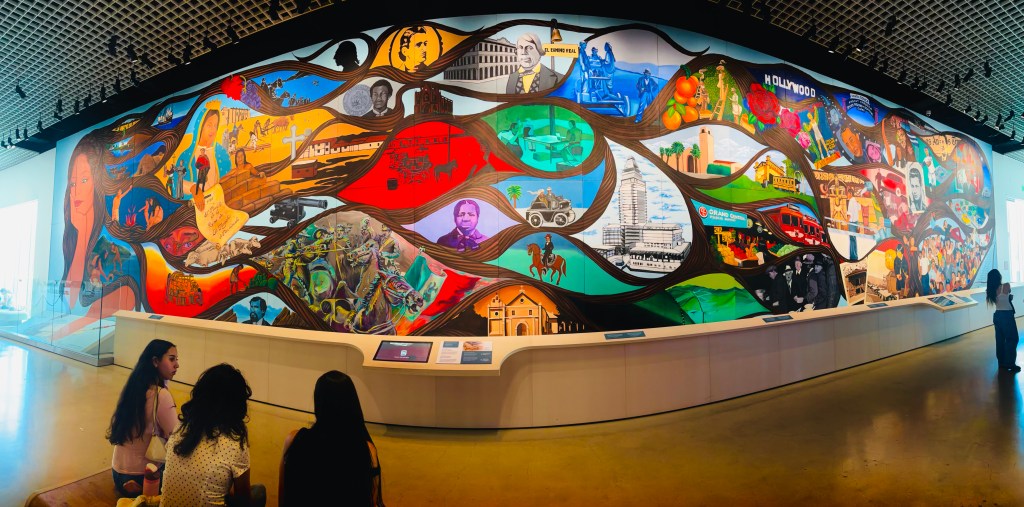
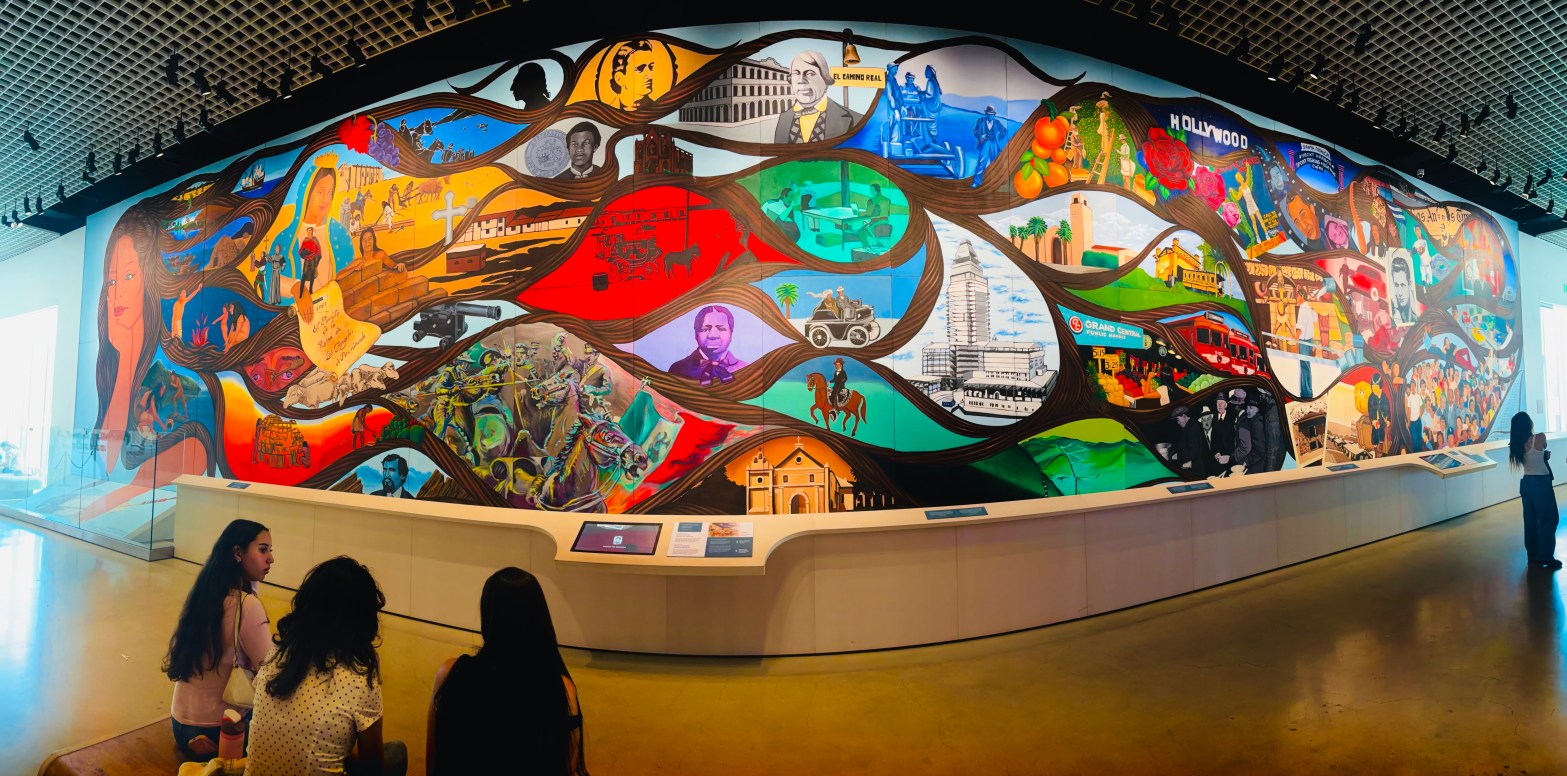
I saw this at the Natural History Museum. The Chicano artist, Barbara Carrasco’s mural was the most captivating visual I saw during my visit, capturing a whole timeline of Los Angeles history moving throughout a woman’s hair. Showcasing a variety of areas of Los Angeles, like Hollywood, The Missions, Black and Indigenous figures, Grand Central Market, red streetcars, and soldiers on horseback, everyone is represented in some way. It all belongs together, the Mural is doing what Marshall Ganz describes, telling the Story of Us for a city that has always had a variety of communities living in the same place at the same time.
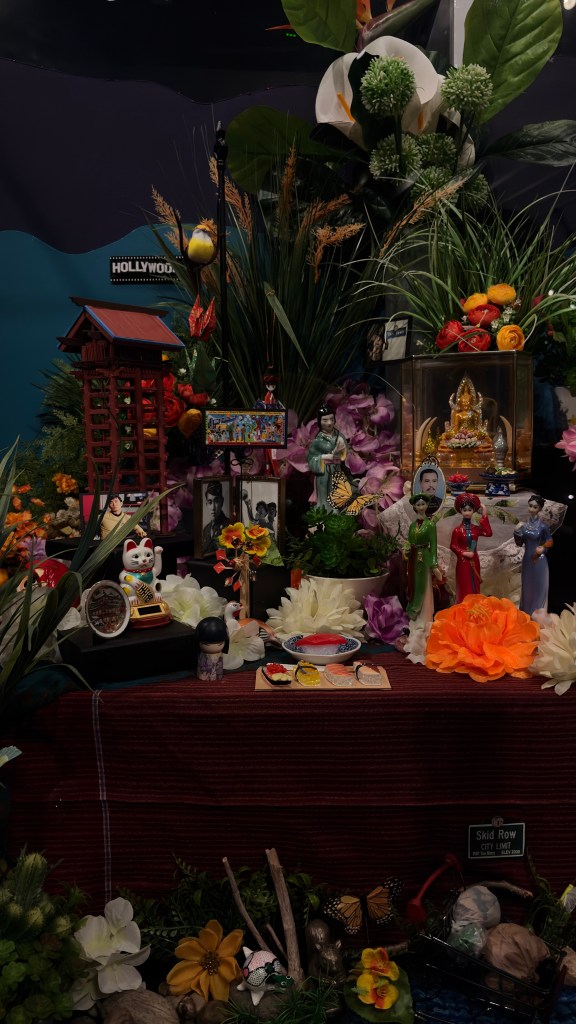
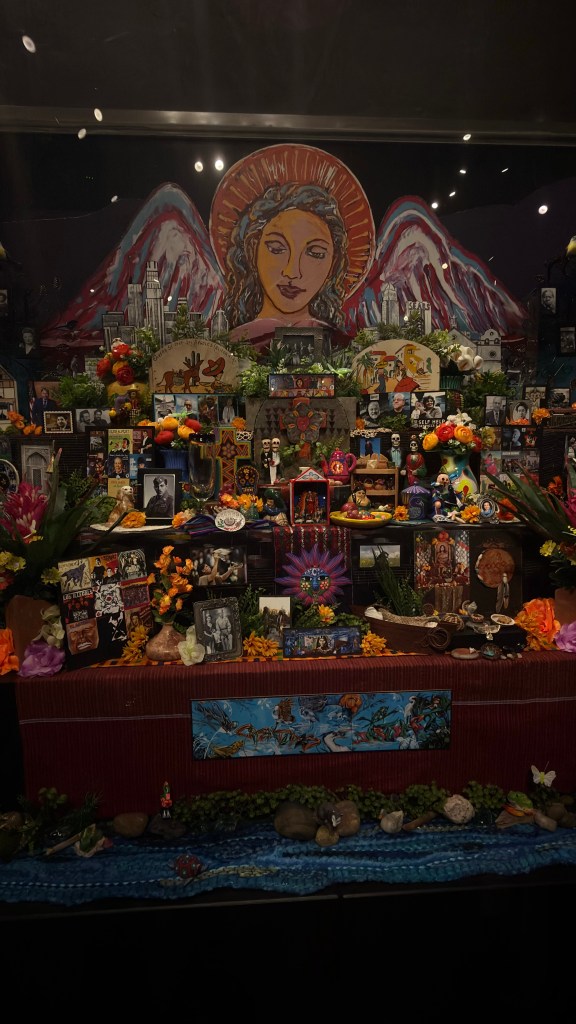
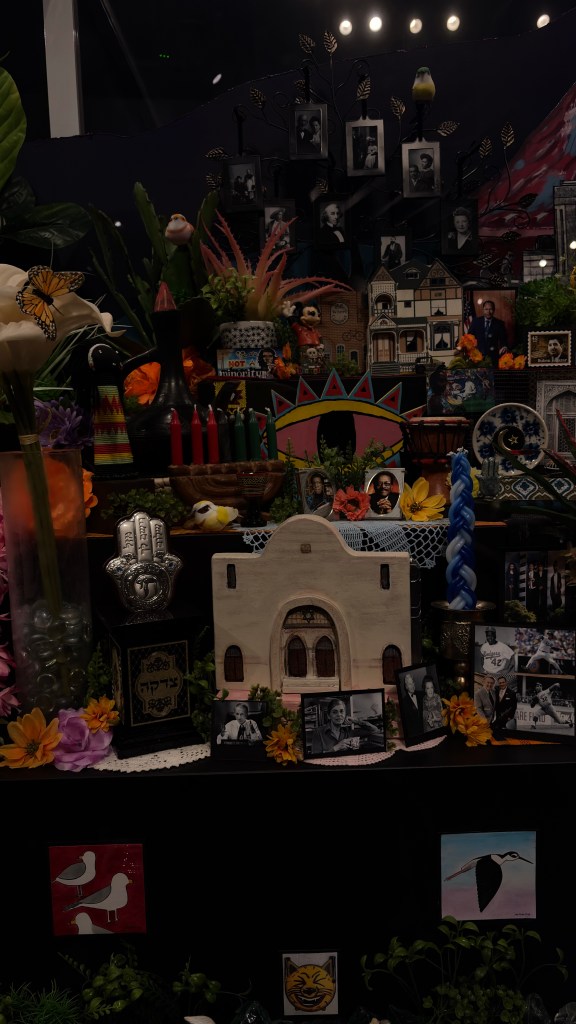
In the Becoming Los Angeles Exhibit, there was an altar, containing a variety of material culture, like a lucky cat, a Buddha statue, the Hollywood sign, and a Skid Row sign, all in the same display. Following the altar, there was a Hamsa hand with Hebrew text, a kinara, a Jackie Robinson Photo, a Mickey Mouse figure, along with a sign that said: “We are not a minority.” There were more mission buildings represented, black and white portraits hanging from branches, and the last part of the altar had an angel with the LA Skyline built onto her wings that can also be seen as mountains. This ties back to what I learned last week about encoding and decoding. Depending on who you are and where you come from, you are going to read those objects completely differently. It covers most of the layers of the community of Los Angeles.
Lastly, in class this week, we also talked about the civic imagination, the idea that you have to imagine what a better world looks like. When guest speaker Sangita Shresthova asked us what we wanted to see in 2050, so many people said community. And as I was in the museum, I was looking at the history of Los Angeles, and that’s something we already have. I think we have to see what has always been here.
 Communicating Change