By Amy Rodriguez
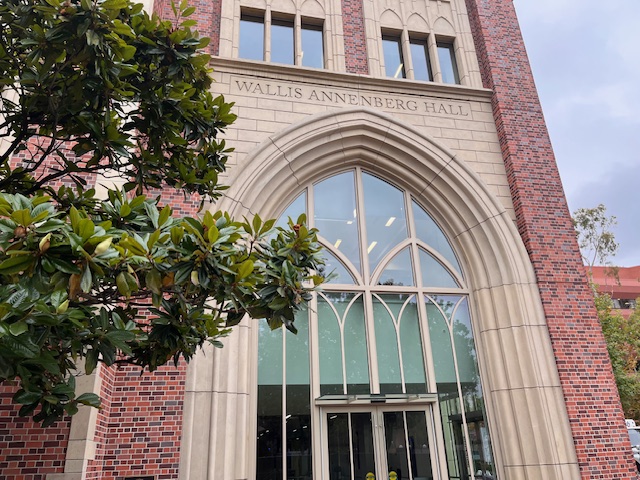
Thin, tall, slender trees hid Walis Annenberg when I first stepped foot onto the campus of USC. The air was hot, sticky, and full of anticipation waiting to be discovered. Before me was a massive, colossal building, which had me hooked onto the hope that all my questions and soon to be made discoveries awaited me before I even stepped foot into the building. As I walked downstairs, I was greeted by Professor Rogelio who wore a fancy business attire which made me wonder if I was too underdressed for my first day at this Academy. Nevertheless, I entered the classroom for a light breakfast, played a game of bingo, and introduced myself to my classmates who, just like myself, were full of anticipation and excitement for the beginning of a brand-new adventure.
Over the course of these four days at the Annenberg Youth Academy, I wasn’t exactly sure of what to expect for the first class of the day, Communications 101. I knew the basics to communication, mainly that it was interactions with people and there were fundamentals to communicating with people that could allow for someone to get higher positions, internships, or even opportunities. However, upon entering Communications 101, I was bestowed with the article titled, “Introduction to Communication,” by Julia Wood, that explained numerous different ways that we as people communicate with one another. Throughout the article, it became very clear to me that the way that I saw communication lined up with Harold Laswell’s Linear Model of Communication or the Transmission Model. The model explains how communication is linear or a one-way process in which one person interacts with another person or how communication is transmitted in a straightforward manner from a sender to a receiver.
The next morning however, as I sat down for Communications 101. Professor Rogelio pulled up slides and began to discuss another model. Specifically, Stuart Hall’s Encoding/Decoding Model/ Theory, which by no means put Laswell’s Linear Model of Communication to shame. Hall’s Model discussed how communication was complex and there were different paths or forms of communication, whereas Laswell’s model claimed there was only one form or path of communication, Hall’s challenged how communication wasn’t exactly linear, and in fact it was more interpersonal, cultural, ideological, connected and was more focused on the interpretation of media and the messages it had for individuals.
With this newfound model, I was challenged in my previous thoughts about communication. A field that I had once thought as simplistic and straight-forward, was more meshed and complex than I had originally thought. However, with the Encoding/Decoding Model, I discovered the importance of communicating from a sender to a receiver, and how through this model, people and more importantly important issues in civic media can be tied to messages in a billboard or ad that is aimed towards me, the consumer where I might not be aware of what is being shown to me. Unfortunately, with this model I side with Stuart, Sorry Laswell!
 Communicating Change