By Daniela Martinez
When most people think about participation, they often imagine someone speaking up in class or taking a leadership role. During my first week at AYA in COMM 101, I learned that participation can take many different forms. Through studying critical media literacy, reading the articles assigned to us, and exploring graphic design, I began to think more deeply about how people communicate, engage with information, and participate in both physical and digital spaces.
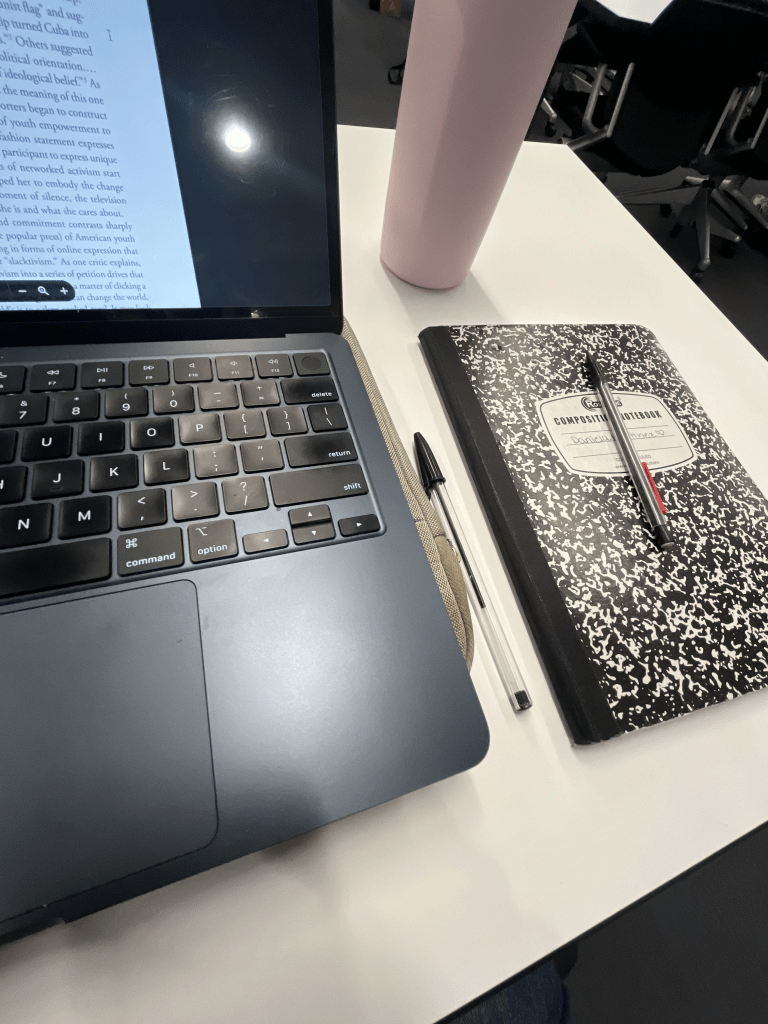
So far, one of the readings that stood out to me the most was Ethan Zuckerman’s New Media, New Civics? Going into it, I did not expect to be very interested. However, as I read, I found myself paying more attention than I usually do. I think part of the reason was that the reading included visuals and examples that made it easier to understand. It also discussed topics that felt relevant to everyday life, especially since technology and social media play such a large role in how people communicate today.
One idea that stayed with me was the idea of participation. Before reading this article, I usually thought of participation as speaking up, sharing opinions publicly, or taking leadership roles. In class, I am not usually the person you would see raise their hand often. Most of the time, I listen to the discussion, take notes, and talk with my partner when we do group activities. As a result, I sometimes feel like I am participating less than other students.
The reading made me think differently about that. Zuckerman explains that people engage with information and communities in different ways, especially through digital media. Not everyone participates by being the loudest voice in the room. Some people participate by listening, learning, sharing information, or having conversations with a smaller group of people. That idea made me realize that participation can take many forms and that quieter forms of engagement are still valuable.
Another topic we explored during the first week was graphic design. Before this class, I mostly thought of graphic design as making things look visually appealing. However, I learned that graphic design is also a powerful form of communication. Designers use colors, images, fonts, spacing, and layout to attain a viewer’s attention and communicate a message. Every design choice is intentional and can influence how people understand information.
Learning about graphic design made me more aware of the visuals I see every day. Whether it is an advertisement, a social media post, a website, or a poster, graphic design affects how people respond to messages. For example, bright colors can attract attention, while certain fonts can make a design appear more professional or creative. Images can create emotions and help people connect with a message more quickly than text alone.
Overall, my first week in COMM gave me a new perspective on communication and participation. The reading by Ethan Zuckerman helped me rethink what it means to participate, while the graphic design lessons showed me how visual communication shapes the way people receive information. Together, these topics helped me become more aware of the media I consume and the different ways people communicate in today’s world. Most importantly, I learned that participation is not limited to speaking the most. Listening, learning, and engaging thoughtfully are also meaningful ways to contribute both inside and outside the classroom.

