During my first week at AYA in COMM101, Rogelio introduced the idea that media messages are intentionally constructed and encouraged us to think about the different elements that make up media. We talked about civic media, representation, and how images, colors, and symbols can all communicate messages to an audience. At first, I thought the propaganda posters reminded me of something I would have analyzed in a history class. I thought I would quickly identify the message and move on. Instead, as Rogelio and my classmates shared their observations, I realized there was much more going on in the images than I originally thought.
The poster that interested me the most was Women of Britain Say Go. During our discussion, we talked about how the poster encouraged men to join the military by showing a women and a child watching soldiers march off to war. The large word “GO!” immediately stands out and acts as a direct message to the audience. However, the more I looked at the image, the more details I noticed. The woman did not seem excited or celebratory. Instead, she looked serious as she watched the soldiers leave. The child also stood close to her and appeared to be holding onto her dress. To me, the image felt emotional because it showed that war affected families, not just soldiers. While I am not sure exactly what the creator intended, it seemed like the poster was trying to make military service look like the right thing to do.
The second poster was interesting for a different reason. As a class, we spent time discussing visual details that I never would have noticed on my own. People pointed out the colors being used, the way the characters were positioned, and the expressions on their face. We discussed how the man was wearing black while the woman was wearing red and what those choices might communicate to an audience. What surprised me most was how much discussion came from details that seemed small. The longer we looked at the poster, the more things people pointed out. I honestly would not have paid attention to most of those details on my own.
This discussion made me think about one of our weekly readings, Representation and Missed Representation by Jimmeka Anderson. Anderson explains that representation is created through images, symbols, and other forms of media. Looking back at the posters, I could see what she meant because they presented a specific view of war, citizenship, and gender roles rather than simply showing what was happening. What stuck with me most from this class was how much discussion came from only two posters. Before class, I probably would have looked at them for a few seconds and moved on. Instead, we spent a long time discussing details that I never would have noticed on my own. Listening to Rogelio and my classmates made me realize that different people can look at the same image and walk away with different interpretations. That was probably the most interesting part of the discussion for me.
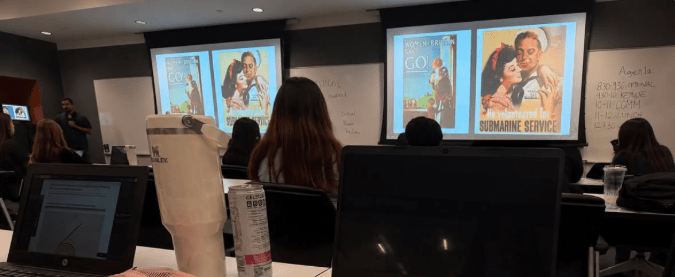
Photo from our class discussion on propaganda posters, led by Rogelio (far left), and the different messages people can take away from visual media.
 Communicating Change