By Evelyn Tsoi

Privilege. It has irreparably shaped my entire upbringing from the moment I was born 16 years ago in Arcadia, CA. My entire life, I have been surrounded by opportunities and affluence. I have taken the little things for granted and overlooked the complex beauty of life and its functions. Although I am merely one week into the AYA Program, I’ve faced more epiphanies during this time than I have in the past few years. I have been challenged to address my privileged ignorance, and truly learn. The most important lesson? Things, people, and ideas aren’t as simple as they seem.
I realized that sentiment fairly quickly during my first Communications 101 class. I had once purely understood communication as the back-and-forth social interaction between others, but it’s so much more than that. Communications represent an all-encompassing field that drives action and change. At its core, communication is defined as a “systemic process in which people interact…to create and interpret meanings” (Wood, 2013). While many focus on the “interaction” part of communication, they often forget that its purpose is to create meaning. Categorized within the broad purpose of “meaning” is a call to action that fuels civic engagement.
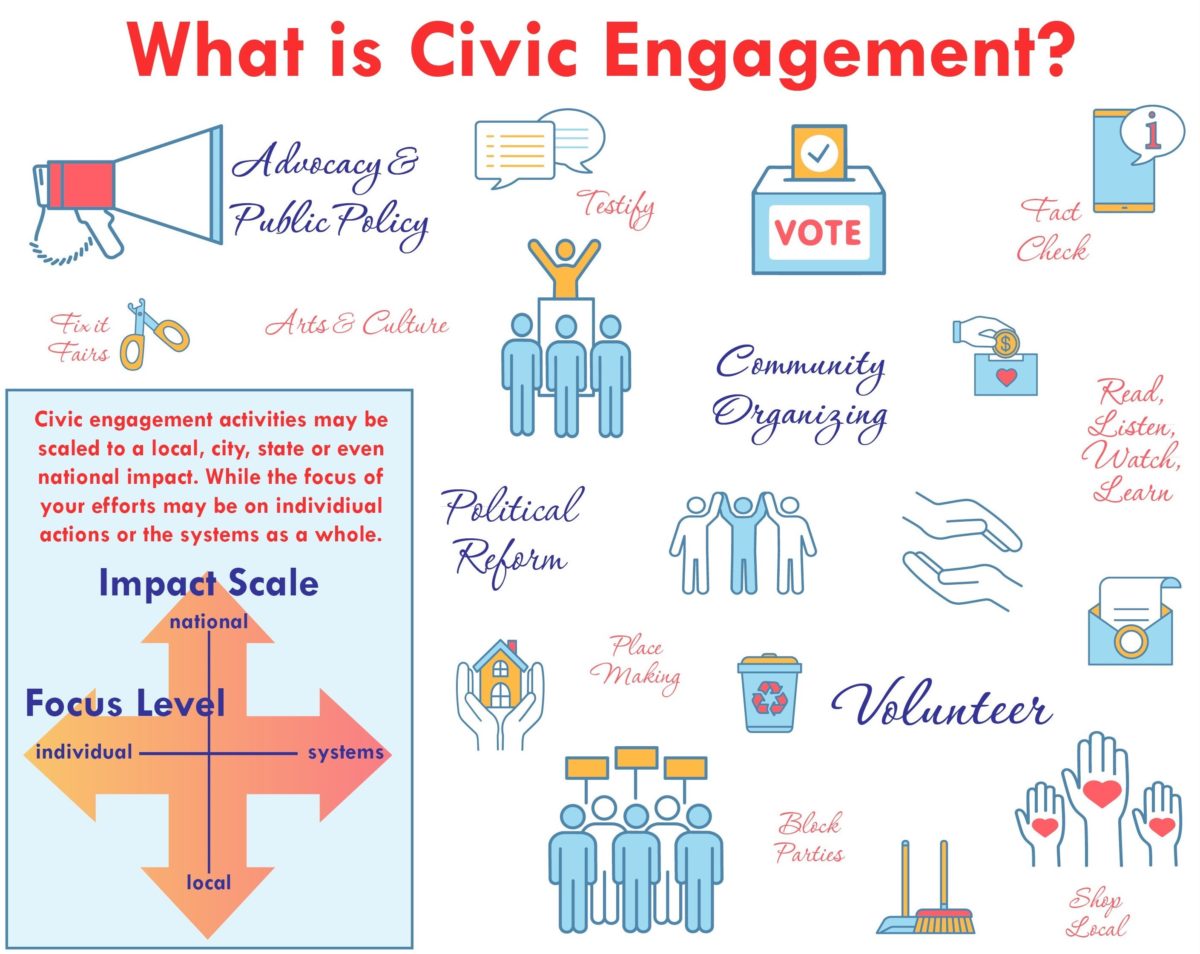
Civic Engagement is a broad and all-encompassing field.
Civic engagement is just as unique and complex as the field of communications. Personally, when envisioning civic engagement, I picture myself focusing on justice-oriented and participatory approaches through canvassing for Democratic campaigns or joining a protest to call for public policy reform. However, for others, civic engagement can mean dedicating time to informal politics by participating in beach clean-ups or focusing on thin efforts like a small donation at the cash register. There’s simply something for everyone.
Even then, just because there’s an action for everyone doesn’t mean everyone will act. I’m fortunate to come from a community of privilege where inequities impact me less than they impact other communities. Thus, there selfishly isn’t as much of a pressing need to address the problematic status quo. Unfortunately, the fact that my community pushes some of our time’s most pressing issues like homelessness and poverty under the rug is nonunique. Across the nation, people from all walks of life are choosing to limit their advocacy and communication overall.
Yet, it is increasingly important within the current polarized political climate, and stark division within our country, that individuals remain engaged and invested in promoting the quality of lives in communities. As former President Abraham Lincoln once duly noted,
“A house divided against itself cannot stand”
(Lincoln, 1858).
Free and open communication is the very basis of civic engagement, so what happens when our nation’s elected leaders can’t even properly communicate?
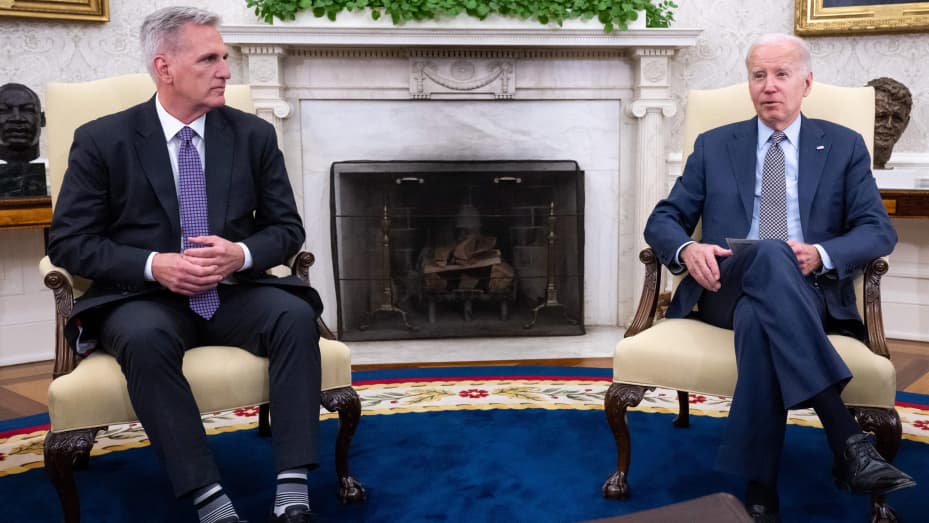
President Biden and Speaker McCarthy discussed the Debt Ceiling.
Earlier this month, a debt ceiling agreement passed Congress after weeks of deliberation. However that deal wasn’t the result of collective discussion, it was the product of closed-door negotiations between President Biden and House Speaker Kevin McCarthy. Thus, benefits to programs like the Supplemental Nutrition Assistance Program (SNAP) were slashed and the polluting Mountain View Pipeline was approved. Such monumental actions regarding the health and safety of Americans necessitate proper communication. Without such, constituents feel unrepresented and thus disincentivized from participating in democratic functions. Kathy Goldschmidt of the Congressional Management Foundation puts it simply:
“As the branch of the federal government designed to be close to the People, Congress bears significant responsibility for rebuilding that trust through better engagement with the People”
(Goldschmidt, 2021).
Researchers have long overgeneralized Americans’ “decline” in civic engagement, so it is time to take a deeper look at the “little things.” For instance, constituents may feel underrepresented in democratic functions, but that doesn’t necessarily mean that they halt all forms of civic engagement. People may stop voting, but they may turn to other avenues of change. Civic Media has coined these avenues as “civic media,” meaning “everything from advocacy journalism to e-government” and “a genre of media and an approach to media making” (Gordon and Mihailidis, 2016). Simply, there has been a rethinking of how people engage with others to fuel the common good. Instead of sitting in town halls, modern-day constituents may prefer volunteering for specific organizations to support issues like environmental protection. Thus offering an activity for everyone even when trust and communication with our elected officials are broken.
As a politically active teenager, I have long viewed civic engagement as democratic, but I’m finally starting to understand that it is so much broader than that. What I love about modern-day civic engagement is that it’s increasingly versatile and accessible. A good citizen today can perform their functions in innovative ways such as digitally with the aid of pop culture instead of having to stand hours under the sun canvassing.

Superman has been used as a symbol for DREAMERS.
Advocates like Erick Huerta have utilized Superman to advocate for DREAMER — undocumented youth raised in the US searching for citizenship — justice. Fanbases like “Potterheads” (Harry Potter fans) have encouraged voter registration through unique Harry Potter-themed campaigns. In today’s day and age, there is increasingly a place for anyone and any type of civic engagement.
I’m truly beginning to understand the complexities of our actions. It’s confusing but simultaneously riveting. The arts of communications and civic engagement are beautifully complex and intertwined. For the first time in my life, I’m finally beginning to see that things aren’t all that simple.
Citations
Wood, J. T. (2013). Communication mosaics: An introduction to the field of
communication. Cengage Learning.
Lincoln, Abraham (1858). Lincoln’s “House Divided” Speech. PBS SoCal.
Goldschmidt, Kathy (2021). The Future of Citizen Engagement: Rebuilding the Democratic Dialogue. Congressional Management Foundation.
Gordon, Eric and Mihailidis, Paul (2016). Civic Media: Technology, Design, Practice. Massachusetts Institute of Technology.


 Communicating Change
Good job, Evelyn just try to add more color.
LikeLike
So good
LikeLike
I love how you mentioned your shifting perspective- the power of education!
LikeLike