Ever since I got into journalism freshman year of high school, I realized I wanted to be a journalist. More specifically, as I was not exposed to much other than print journalism and some journalism online, I’ve wanted to be a writer—that is, until I’ve recently been exposed to the world of broadcasting.
Broadcast journalism never had much appeal to me—but as I’ve recently expanded my horizons in Journalism 101 in the studios of Wallis Annenberg Hall, the rush of watching our classes’ first news anchors awakened an alternate passion for me in journalism that I never expected to have.
In Professor Allan Lopez’s class, we’ve been more hands-on with broadcast journalism this week rather than the usual lectures surrounding it. We spent a lot of time in Annenberg’s studios—first, on Tuesday, we recorded an introduction to our Vox Pop assignment in the podcasting rooms. Sitting in the room with two other classmates, on the table before us lay a headset for each of us as well as a microphone. We placed the headphones on our ears as we gushed about how we sounded like we were actively listening to ourselves in an already-created podcast as we spoke into the microphone. Stunned, we realized we could also see ourselves on a screen on the wall and took lots of pictures before returning to the lounge area where I made a plethora of new friends that day.
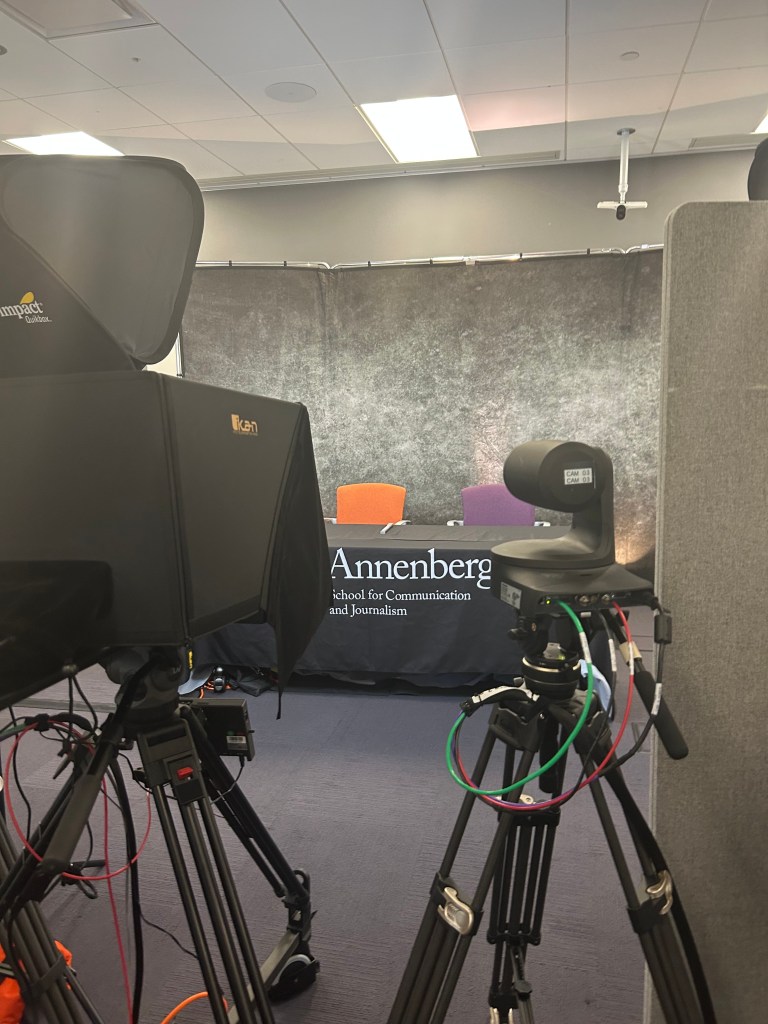
On Thursday, we did a studio newscast in a room near the one we did the Vox Pop introductions in. There were three options—to be a writer, to do behind-the-scenes work or to be the star of the show—a news anchor. Being the print journalism girl I am, I volunteered to be a writer, as that was the closest to what I was used to with print. It was between that or working behind-the-scenes of the newscast—being an anchor never even crossed my mine. Curiously enough, by the end of the time in the studio, that’s just what I ended up doing.
Nobody forced me to get up there. But as I sat, the script in hand, watching attentively to one of my close friends trying out the anchor position, I felt some strong exhilaration watching the others scramble to do their jobs supporting his role and most significantly, the exhilaration I felt imagining the anchor to be myself. I instantly wanted a greater role—to be more involved in the storytelling process. Something I believe strongly in is that journalists are on the frontlines of history—being the firsts to tell the stories that will be studied by the historians and students of the future, showcased to the world. When I decided I wanted to be a journalist, what I wanted to contribute to society was telling the stories that would soon enough become history and to do so in its best quality—but my horizons have recently expanded to the realization that there is more to news than print to do just this.
After those who chose the role of an anchor completed their broadcast, Professor Allan Lopez, in wanting to provide the opportunity to try any and every role the students wanted, announced that before class ended, if we wanted to try practicing to be an anchor for next time, we could line up and wait to read off the teleprompter. Still considering that choice, as it, at first seemed a nerve-wracking concept, I waited on it and did not yet get in line. However, still wanting a greater role than just analyzing the script (as I already had done), the student that was working the teleprompter got up, and I quickly offered to take her place. I learned how to work the teleprompter and assisted the practicing anchors on their endeavors to try something new before trying so myself. After watching the scene for a while with how swiftly my classmates got the hang of speaking for the broadcast, I handed my role on the teleprompter to another eager classmate as I worked my way over to the line to be an anchor with a friend.
After discussing a very pressing topic with my co-anchor (regarding what volume to speak at) out of nerves, I finally signaled to my classmate at the teleprompter that we were ready to begin. I chose the lines of my friend that was the original anchor that day as I felt I had paid the most attention to his parts while I was watching from the sidelines. Aside from the slight giggling when I almost introduced myself as ‘Winston Sanchez’ reading from the teleprompter (I at least corrected myself as Kayla Penhasi before I could actually do so), I felt as I performed surprisingly well in front of the camera. I have always viewed myself as someone strong in public speaking, but in those cases I have usually practiced to myself a million times over before getting in front of an audience of any kind, so the natural feeling that came to me when I performed my lines was unexpected to say the least.
In Communications 101, in our assigned media to delve into for homework as assigned by Professor Rogelio, we further explored the digital audio mediums with an intro to podcasting. We read a Variety article titled, “Joe Rogan and the Fifth Estate: How the Podcaster and a Group of Cable News Exiles Became More Powerful Than Traditional Media,” and listened to numerous podcasts that served as examples for our findings in what we learned about podcasts from our daily lectures.
In the Variety article, something I found particularly interesting was the belief that Trump won the election over Harris by the podcasting medium. Unlike traditional media with writing and print, the audio digital mediums do not require literacy—anyone can listen to beliefs over audio, as podcasting is as listening to a conversation—though not everyone has received the proper education to be literate and thus, podcasting has a farther reach in spreading ideas than writing would.
Additionally, as covered throughout Professor Rogelio’s lectures in class, podcasting is also a strong form of reporting as when people listen to a podcast, since podcasts are rather conversational, it creates an emotional connection with the listener—a connection in which would not typically be available if it were put in writing.
My former perspective on podcasting was that we shouldn’t listen to podcasts to get our news, as anyone, even those without the proper qualifications to can buy a microphone and post online. However, during Rogelio’s lectures, although we learned how podcasting can be harmful in this way, there are also many benefits to podcasting (as long as started without malicious intent). Podcasting provides the ability for a voice in the public sphere for communities that are not represented in traditional media. These marginalized communities can raise their concerns and even start movements with the spread of ideas they put out through their words. And so, as long as we are cautious as to who we listen to with these podcasts and fact-checking their words, I believe podcasting is a truly beneficial audio medium to our world.
The Week Two experience in Journalism 101 at Annenberg opened up new possibilities for me in the journalism field that I would have not explored or even imagined were for me if not for this program, and Communications altered and added to my perspectives on certain concepts. Disappointed that we only have one more week to look forward to at Annenberg, I am grateful and cherishing all the new knowledge, experience, strong bonds and connections I’ve made at USC these past two weeks, from broadcasts to podcasts.
 Communicating Change