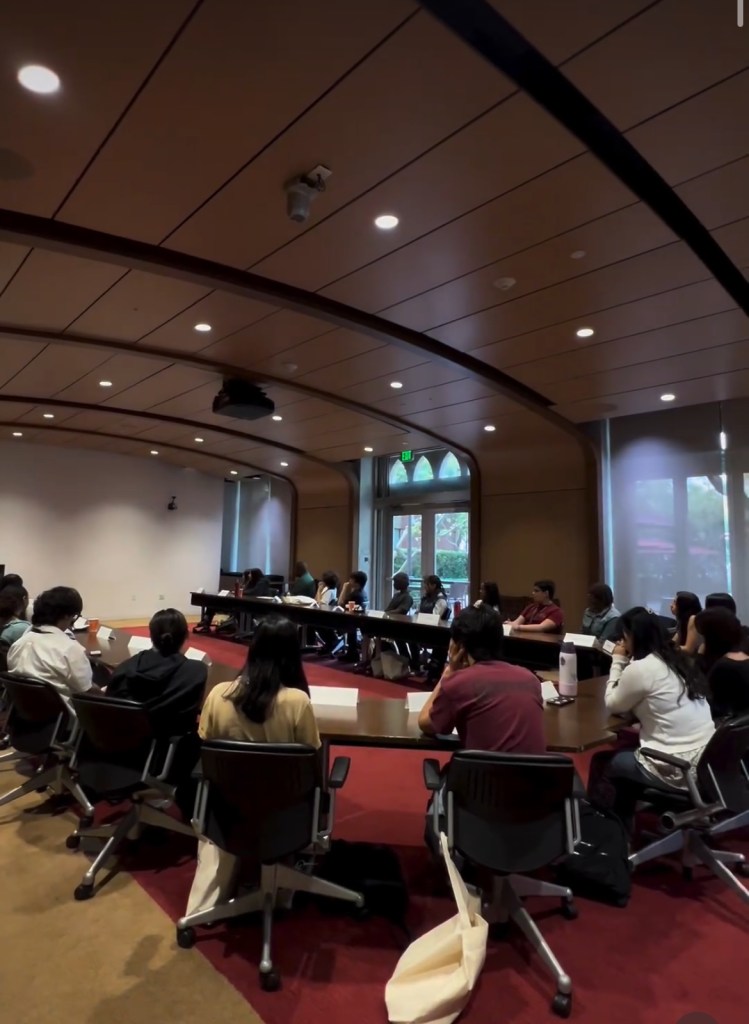
Growing up, the dinner table was my crucible for mastering social customs and manners. Aside from eating, the dinner table served as a transformative catalyst for my communication skills, etiquette, and family unity,– similar to AYA. This week, we reflected on the significance of placement of seats in the lecture room–a space for profound learning and stimulating discussion. Distinct from the standardized classroom, the desks in AYA are arranged in a U-shape. Reminiscent of the dinner table, this fostered the development of respectful etiquette, behavioral cues, and social skills. This newfound realization enabled a fresh insight to my intellectual exploration at Annenberg. Join me as I reflect on my second week at AYA.
The U-shape seating creates an atmosphere where every lecture feels like one big endless conversation and a large interaction. Amidst these interactions, there is also a lot of awkward exchanges. I find myself constantly locking eyes with other students in front of me. Professor Taj Fraizer allowed us to look at “awkwardness” through a different perspective I never considered– one that views it as a built social construct humans abide by. A custom that doesn’t exist unless we give reality to it. This took me back to the endless awkward interactions I experienced, attempting to converse with new guests and extended family members. I didn’t understand the obligation to sit through all these events. Why was my 6-year-old presence so significant to my family? At the dinner table, the notion of “awkwardness” became a myth.
This week taught me the true meaning of social customs. Social customs are more subjective than they are objective. They are collective beliefs and practices unique to each culture. During this class conversation, I pointed out the importance of social cues for public safety. They establish norms that govern public conduct, such as refraining from loud outbursts in public or showing respect by not raising our legs on dinner tables. Sounds obvious, but it highlights how these unspoken customs shape our society. Professor Frazier followed up with a statement proclaiming there is context behind everything we do and say. The unique blend of our diverse cultures is what contributes to the rich diversity in Los Angeles, simultaneously contributing to the unique “melting pot” that embodies our nation’s multifaceted identity.
Different individuals interpret media through their unique upbringing. This was prevalent when we answered a discussion question, “Do you think you’re properly portrayed in the media?” As we discussed the detriment of stereotypes, all of us students seemed to have different approaches and perspectives on their truth to the answer of this question. As Mark Shoofs suggests, “To be human is to have preconception.” highlighting the idea that our perceptions are influenced by our existing beliefs and personal histories. In communications we learned, participatory culture : the active participation creations and sharing ideas of media content fostering community and ownership. We also learned, ”Participatory politics describe how young people blend culture and media practice with peers, acquire essential digital literacies, discover and share information, express their viewpoints and relevant concerns, cultivate and sustain communities, and translate all such knowledge and skills into direct actions – whether activism or street mobilizations.“ (Jenkins & Lopez, 2018). In journalism, with the guidance of Professor Allan Lopez, we successfully created our first news cast as the 2024 AYA Cohort. This week, we were also challenged by creating our own piece of media– a podcast– in representations of a cause we deem as important, specifically for the youth. For my podcast, I interviewed two representatives at Gain FCU emphasized the importance of a financially literate generation for us. Reflecting on skills I learned in AYA, particularly from Professor Allan Lopez’s journalism course and the investigative journalism session with Professor Mark Shoofs, I successfully organized and led the interview. This helped navigate the conversation effectively and delve into essential financial topics.
Throughout the week, we explored different cultural customs. Music, being “inherently democratic” is a shared practice that amplifies voices through common lived experiences. Similarly dances like hip-hop and Krump, emerged as a political movement rooted in expression and fulfillment, furthering my understanding between culture, media, and community engagement.
As I learn time and time again– my family was right. Their direction allowed me to transcend my comfort zone, develop strong communication skills across diverse groups, and developed my multifaceted identity. These experiences have been crucial not just for navigating society successfully, but thriving as a student at AYA. My family’s guidance and AYA’s educational environment have shaped me into someone who confidently navigates diverse social settings and values intellectual growth. Like the dinner table shaped our family, through lecture and conversation, we’ve created our own customs within our AYA family.
By Milena Tarverdyan
References
Jenkins, H., Lopez, A. R., (2018) “On Emma González’s Jacket and Other Media: The Participatory Politics of the NeverAgain Movement”
 Communicating Change