
By: Zoilo Pérez
The future of women’s sports in terms of inequity depends very much on how much interest (we) as consumers sustain for equity and womens effort as athletes.”–Denise Kwok, USC interim athletic director
Over the past few decades, women’s sports have seen remarkable growth as barriers keep on breaking down. Marginalization and inequities when it comes to funding and recognition have always hindered the progress, but some feel that the playing field is becoming more equal.
“I used to cover women’s sports when they couldn’t even get coverage in the local newspaper,” said USC Annenberg Prof. Miki Turner. “Has it gotten better? Yes. Is there much more that needs to be done? Yes. It’s kind of like a victory on ice,”
At USC, a school in which the NCAA champion women’s basketball team had to play in a space that resembled a high school cafeteria in the ‘80s and early ‘90s, things are getting much better. Not only is there a women president, a new stadium being built by donor money to house the women’s soccer (a two-time NCAA champion) and lacrosse teams, but the current interim athletic director is also a woman. Denise Kwok, who has been working as the executive senior associate athletic director for student-athlete development.
“I think that women’s sports is gaining a lot of ground both on the collegiate side,” she said. “You have Angel City, a football organization, the WNBA…There are a lot more marketing efforts around the female athletes. I also think you have a population of young girls and mothers who participated in sports and athletics as youth. I think that the generation that’s coming up, there’s a lot more equity in even how we view sports and how women think of themselves as athletes.”
The road to equity all started on June 3, 1972 when Title IX was passed. The law ensures equal opportunity and prohibits discrimination in education and athletics based on sex or gender. This is the first major policy that gave women a step forward to equality. As a result, in the last two decades, participation in women’s collegiate sports increased, going from 30,000 participants to over 150,000.
Fifty years later, in 2022, the House of Representatives passed a law that would give the US women’s soccer team equal pay as the men’s team. The team’s 2019 World Cup win made it clear to everyone that women deserved the same pay as men. In addition, this regulation is now used for 50 different sports across the U.S., which shows the progress made in terms of wages.
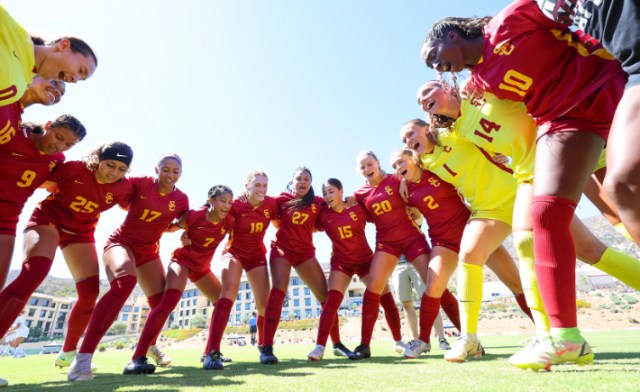
Photo Courtesy of USC Athletics
USC Annenberg Prof. Stacy Scholder, who teaches a class on sports production and broadcasting, feels that future progress comes from women speaking up more often.
“They need to start demanding more,” she said.
John C. Fremont High School women’s basketball coach Melanie Derouen agrees.
“Women just have to keep raising awareness about the issue. Soccer just got equal pay( the same as men). They really fought for it and didn’t stop until their pay was increased”.
USC’s history with women’s sports is legendary. They have fought on. The Women of Troy have collected over 36 national championships, including 26 NCAA titles. Two of the most memorable championships would be the 1983 and 1984 NCAA Division I women’s basketball tournament wins led by Cheryl Miller, Pam and Paula McGee, Rhonda Windham and Cynthia Cooper. Last year’s team seems destined to perhaps claim another NCAA title, but until the arrival of high school phenom Juju Watkins, few people paid attention,
To this day the men’s basketball team has 0 national championships but somehow gets more television coverage. When will that get better? Kwok says there are a lot of things in play to determine equitable coverage.
“That’s hard to say because a lot of that is market driven,” Kwok said. “It’s determined by how much Nike, ESPN or some of these big corporations want to put into it. It’s like how many women are going to go buy a really cool shoe by Naomi Osaka. Is there a broader audience that’s just not men or women for that kind of product.
“It’s also about raising our daughters and our sons to conceptualize women as equitable athletes and conceptualize their game and their product to what’s happening on the men’s side. I think you’re starting to see that but it will all depend on how we as people, as consumers decide to take it on and invest in it.”
Overall, there is hope for women’s sports to reach its full potential. It continues to grow, it is a progressive non-ending cycle of growth. No doubt that inequality remains but the future still remains big. To name a positive situation, coverage expansion leads to more viewership which eventually results in marketers investing in the sport. That is one of the many ways women’s sports can develop significantly.
“In women’s sport, obviously we are mandated federally by Title IX to provide equitable access and opportunity and resources,” Kwok said. “But beyond that, we’re really trying to ensure that we are investing in our women and their development professionally and personally–and that they know even if a professional sports career isn’t necessarily as lucrative as a male’s, a football or NFL career, there’s really exceptional opportunities for them and that they can go on and be really successful.”
 Communicating Change