
By Jayla Walker

Katrin Davidsdottir in “The Body Issue”, published annually by ESPN. Photo by Benedict Evans.
Female athletes are always engaged in battle, both on and off the court. It’s always been their femininity against their athleticism. Part of the ongoing conflict is how far women are willing to go to get an endorsement deal. Or perhaps the better question is, how far do they have to go to get equal endorsement opportunities like men?
From NIL deals, to commercials, to fan popularity, men’s sports rule the media. But what does this entail for women looking to make an appearance in the same industry? As sex appeal has gained so much popularity in the entertainment business, displaying sexy content in marketing strategies is what tends to sell these days. This introduces a common theme in the media of women showcasing their bodies to gain popularity and recognition for the sport they play, even if it means that their image is prioritized over their athleticism.
“The camera and photos really don’t look at their play, but it looks at… what their bodies look like in uniforms that… are flattering to the male gaze, but our women really struggle sometimes wearing those uniforms that are very revealing,” says Julie Rousseau, associate athletic director for diversity, equity, and inclusion, and adjunct professor in gender and sexuality studies at the University of Southern California.
In speaking to student athletes at USC, many of them felt that appearances play a huge part in being endorsed.
“Obviously there is a beauty standard, and… you can assume that… if you look better… you’re going to get more likes on Instagram, you’re gonna have more followers. That’s what attracts brands,” says USC women’s basketball recruit, McKenzie Forbes.
The concern isn’t how women decide to present themselves in order to get an endorsement. As a matter of fact, many athletes use their body image as a form of empowerment in sports.
“I don’t really follow the normal stereotypes… When I compete, I’m a lot more flashy, and kind of tuned in more to my feminine side… that’s just who I am as a person,” says Johnny Brackins, a hurdler for the USC men’s track and field team.
“When I get on race day, I like to dress up a little bit,” shares USC women’s track and field athlete, Jasmine Jones. “I like to feel like it’s a performance because it is. We’ve trained all year for this, we get to go out and do it now.”
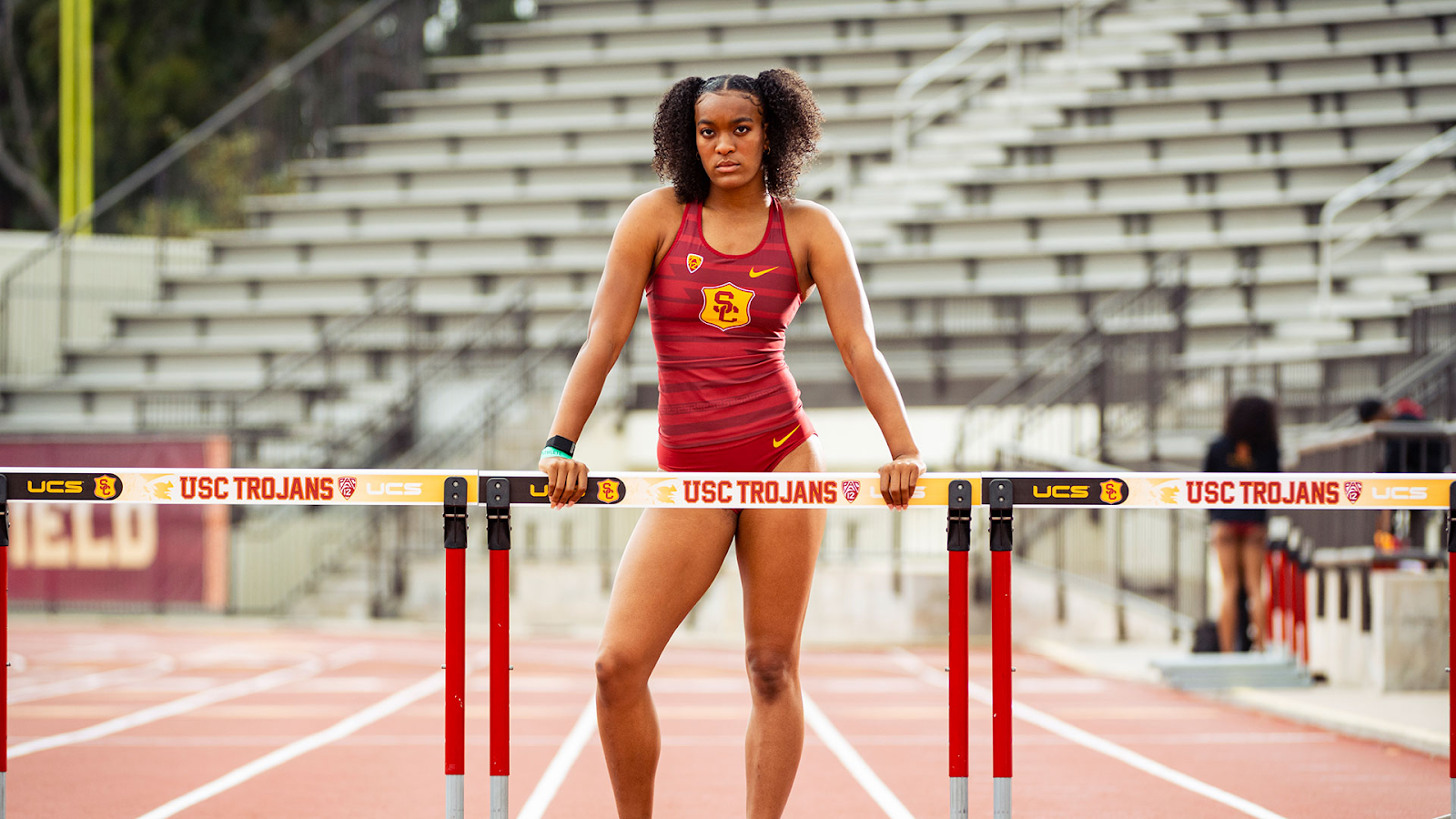
USC women’s track & field athlete, Jasmine Jones. Photo by John McGillen.
Especially today, we see so many athletes getting endorsed because it generally helps to look more appealing for brands.
“Angel Reese… with her being so feminine, I feel like that helped her get a lot of… NIL deals, beauty brands wanting to reach out,” remarks Juju Watkins, USC’s newest addition to the women’s basketball team.
“You do get that double whammy of ‘Oh, she’s an athlete and she’s pretty, she’s conventionally attractive’, and that can be used in your favor. And I’m like ‘period, that should be used in your favor’,” adds Forbes.
“Ultimately, it is their choice, but we want to make sure that our student athletes, our women, are aware… so that you know what you’re getting yourself into,” Rousseau comments on spreading awareness among USC’s student athletes.
Image plays a huge part in getting brands to reach out, and this can be really beneficial to the career of a female athlete. Arianna Uhalde, a USC professor on Marketing Communication & Promotion Strategy, as well as on Sports Marketing, highlights the importance of an athlete’s authenticity when it comes to marketing their brand.
“Athletes’ unique personalities, backgrounds, and activities attract attention from the media, and media will often develop and publish stories about athletes without directly mentioning athletics or fitness,” she says.
However, the issue that arises is the sexualization and objectification that women receive when they look a certain way, whether this is depicted in their uniforms, or in their facial appearance.
Michael A. Messner, retired professor of sociology at USC and expert in the sociology of sports, especially related to masculinity and femininity, and youth leagues, says that “the sexual showcasing of one’s body for commercial gain may ‘empower’ one individual but it also can serve to disempower women and girls as a group, because it emphasizes the importance of sexual attractiveness, while de-emphasizing what’s really empowering about sports.”
Even in athletic uniforms, the sexual attractiveness of the uniform may be prioritized over its comfortability. Women’s beach handball uniforms advertise sex appeal, intentionally bringing attention on the athletes’ bodies rather than any practical or performance-enhancing reasons.
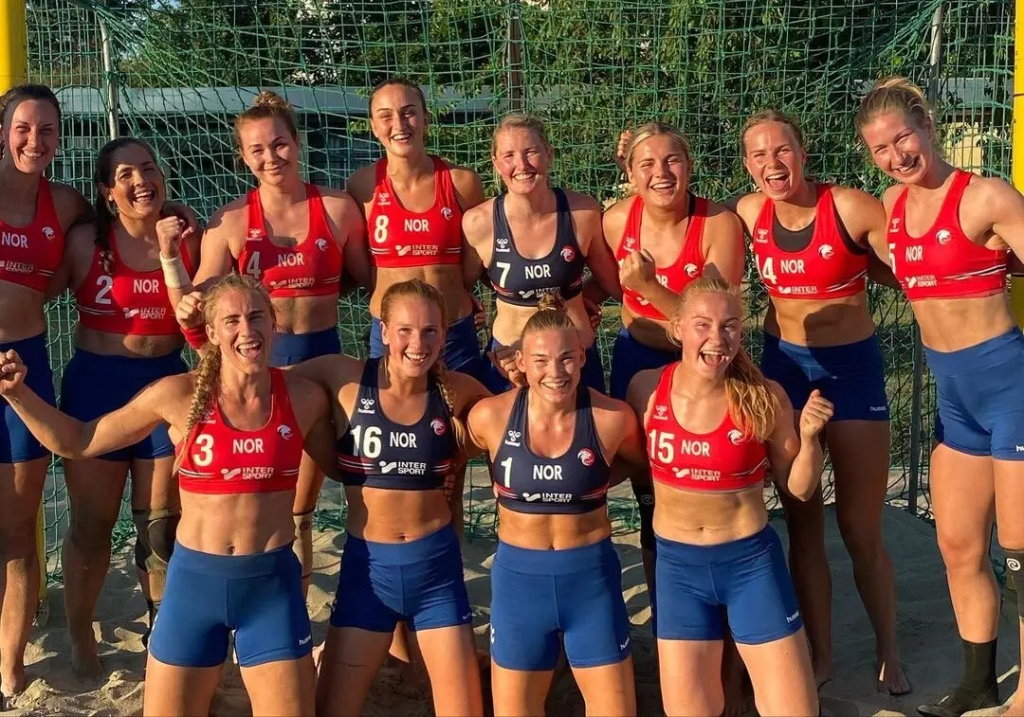
The Norwegian women’s beach handball team wearing shorts rather than bikini bottoms. Photo by Norwegian Handball Federation.
“Whoever made our uniforms was definitely a man, and definitely did not play volleyball,” says Mia Tuaniga, a volleyball setter on the USC women’s volleyball team.
“Unfortunately, there is a long history of the objectification and sexualization of women in sports and other industries… where patriarchal values persist… In the sports industry (in which physical performance is central), women are critiqued more for their physiques and sex appeal,” Uhalde adds.
Uhalde points out a scene in the movie “A League of Their Own”, where female baseball players are required to wear relatively revealing uniforms.
A viral video shows one of Tuaniga’s teammates shagging a ball under the bleachers. “And obviously the camera angle is showing her butt… And she’s in spandex… she’s in uniform…” Tuaniga emphasizes. “[It’s] stupid as far as how much attention women’s volleyball gets only because of what we wear. But at the end of the day, I can’t really change that because… I mean, what am I supposed to do? Have a lecture with every man that comments?”
Tuaniga is right. At the end of the day, changing this issue would mean changing the minds of the public.
In order to change the sexualization that women receive in the media, “you’d have to change every individual human being,” says Dr. Daniel T. Durbin, founder and director of the USC Annenberg Institute of Sports, Media and Society, and creator of the African-American Experience in Major League Baseball research program. “I may look at an image of an athlete and go, ‘oh my gosh, that’s artistic, that’s aesthetic, that is powerful, that is strong.’ And somebody else may look at them and go, ‘oh, that’s hot.’”
“The most important thing to make change for female student athletes or women in sports is that men also are educated about what women go through… the cameraman behind the camera—they need to be just as educated…” explains Rousseau.
Furthermore, it is important for marketing strategies and endorsements to portray women athlete’s bodies in poses that do a better job of showcasing their athleticism and talent. A study about the portrayal of women in sports illustrated conducted by Lincoln Kensicki and a few other scholars found that images of female athletes were more passive and less task relevant.
“[If] you are an athlete, and I put out an image of you dominating some athletic competition, somebody out there can still sexualize the image. And that’s what they’re going to do, but the image itself is task relevant,” Durbin clarifies. “It promotes your identity as an athlete and it creates a certain visual power for you as an athlete. It shows your dominance. It shows your skills.”
Durbin makes an excellent point. While it helps to look conventionally attractive, the media needs to advertise the athlete’s abilities. An athlete’s masculinity or femininity shouldn’t be prioritized over their skill.
“I don’t let me being a woman take away from any of my aggression or passion towards the game,” says Koi Love, an athlete of the USC women’s basketball team.
“We’re allowed to be aggressive. We’re allowed to be passionate. We’re allowed to scream, and yell, and be physical,” adds Forbes.
In the end, the biggest question remains how we as a community can support these women athletes looking to get endorsed, and how we can spread awareness of the sexualization and expectations that both male and female athletes are faced with in the sports industry.

Soccer player, Son Heung-Min, modeling for Calvin Klein. Photo by Calvin Klein.
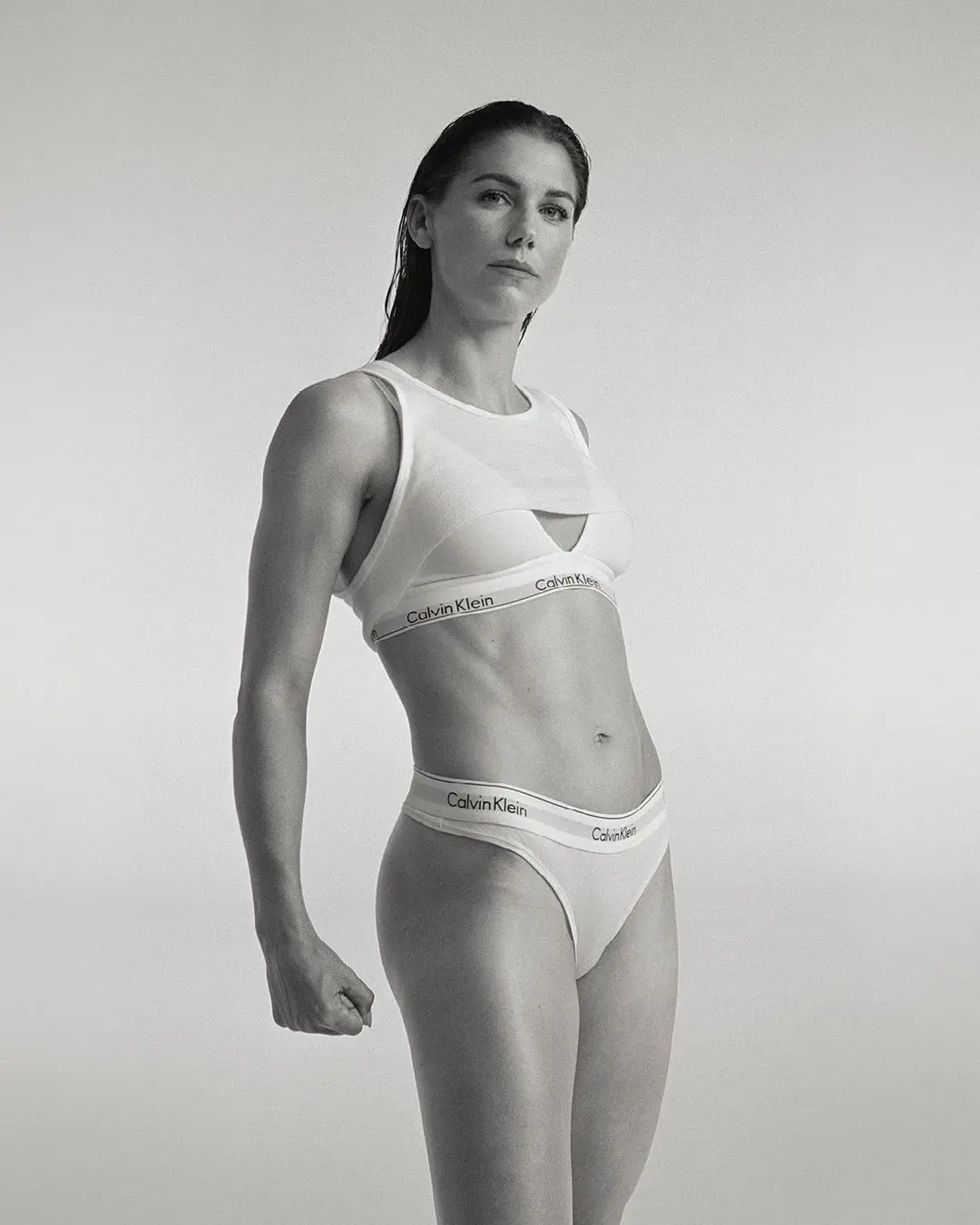
Soccer player, Alex Morgan, modeling Calvin Klein. Photo by Calvin Klein.
“The one thing that those in the media can do is stop this disparity in the images that are created, stop portraying female athletes in passive poses, in task irrelevant poses,” Durbin urges.
“One of the biggest pieces to change is that men have a better understanding of what women go through,” emphasizes Rousseau.
“If more, varied organizations support female athletes and teams like they support male athletes and teams (with resources, promotion, etc.),” says Uhalde, “I suspect we’ll see shifts in public perceptions, attitudes, and expectations. Businesses like The Sports Bra, Togethxr, and ACFC are doing great work. We’re moving in the right direction but still have a long way to go.”
Fortunately, Uhalde is correct. While we still have a ways to go, we’re making progress. Intent in sports marketing strategies is improving, and so many athletes, both male and female, are saying no to the common stereotypes, sexualization, and expectations placed on them by the media.
“With women’s basketball, there’s a lot of different ways of expressing yourself and your sexuality,” exclaims Watkins.
“I think women are saying ‘No, I’m more than just my body. I’m capable of doing a lot more’,” Rousseau believes.
“Every stride I’ve made off the court to step into my femininity also showed on the court,” Love declares.
“I really don’t care for the expectations, I kind of try to break them,” adds Brackins.
But Rousseau’s biggest advice to female athletes entering the sports industry is summarized in just three simple words.
“Know your worth.”
 Communicating Change