Astha Munot
This image illustrates the compelling necessity for media literacy in society.
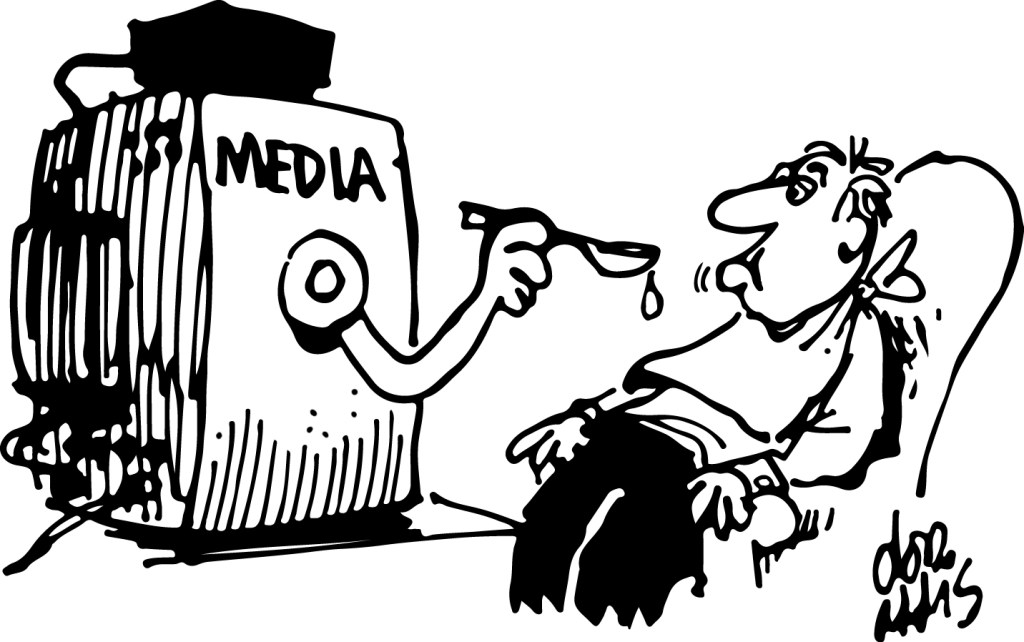
Traditionally, “spoonfeeding” resembles a lack of awareness or ability by the person who is being spoonfed. It shows an inability of the person to understand or even care about what they are being spoonfed, as long as they are consuming it. And this picture represents exactly that. The television set is “spoon-feeding” the man media, and the man is mechanically consuming the media without contemplating the information, let alone digesting it. This shows how ignorant and incompetent society can often be. We frequently tend to succumb to the influence of the media that surrounds us, often neglecting to critically analyze its purpose and underlying motives.
For instance, when we encounter a Starbucks billboard advertising a tempting drink, typically our immediate response would be, “That looks delicious! I want one!” Rarely do we perceive the billboard as a method of strategic advertisement sought to persuade us to purchase an overpriced beverage solely for the sake of the company’s financial gain.
I think this idea of becoming blind to the tricks of media, commercial media in particular, is portrayed perfectly in the scene Professor Lopez showed us from the movie “They Live,” where it illustrates the glasses helping the man look beyond the appealing media he sees everywhere and understand the real motive behind it and the deep-rooted messages being sold to the public.

This ability to understand and dissect media is what media literacy entails. According to the Critical Media Project of 2023, “Media literacy is the ability to access, analyze, evaluate, and create media in a variety of forms.” Being media literate essentially means being able to decode what the media is trying to communicate to you, intentionally or unintentionally. I remember on the first day of AYA, I learned about Stuart Hall’s perspective on communication and how it involves two sides. The author encodes the messages, and the receiver decodes the message and makes sense of it. That is what communication is. That is what media strives to do: to communicate with the audience so they understand the medium’s intended purpose.
Moreover, it is important not only to be media literate but also to look at media from a critical media perspective. Critical media literacy allows us to understand how power is distributed in society and how that distribution affects different demographics or people in general. For years, the media has perpetuated ideals like pale skin and slim bodies for women, mandating these characteristics to seem superior to other skin tones or body types. These stereotypes induce substantial adversity, especially among youth. It has instilled an image of an idealized person, leading to W.E.B Dubois’s concept of double consciousness. The media has romanticized this dominant culture, provoking people to feel a sense of embarrassment towards their own cultural identities, because they are different from the norms of the “dominant culture” that they felt the necessity to conform, especially for the younger generation.
Ultimately, as Generation Z, it is our responsibility to become critically media literate. It is important to be aware of biases, manipulations, or hidden agendas within media content so that people can make informed decisions with a more critical mindset when consuming media.
 Communicating Change